Diffusion & Flow Matching Part 2: Understanding Flows
- A vector field tells you which direction to move at each point in space
- A flow is the map that shows where every point ends up after following the vector field
- This is the mathematical foundation for flow matching: we’ll learn a vector field that “flows” noise into data
Understanding Flows
In flow matching, we learn a vector field that transports samples from noise to data. But what exactly is a vector field? And what does it mean to “follow” one? This post builds the intuition you’ll need for everything that follows.
Intuition: Think of a River
Imagine a river with currents flowing in different directions at different locations.
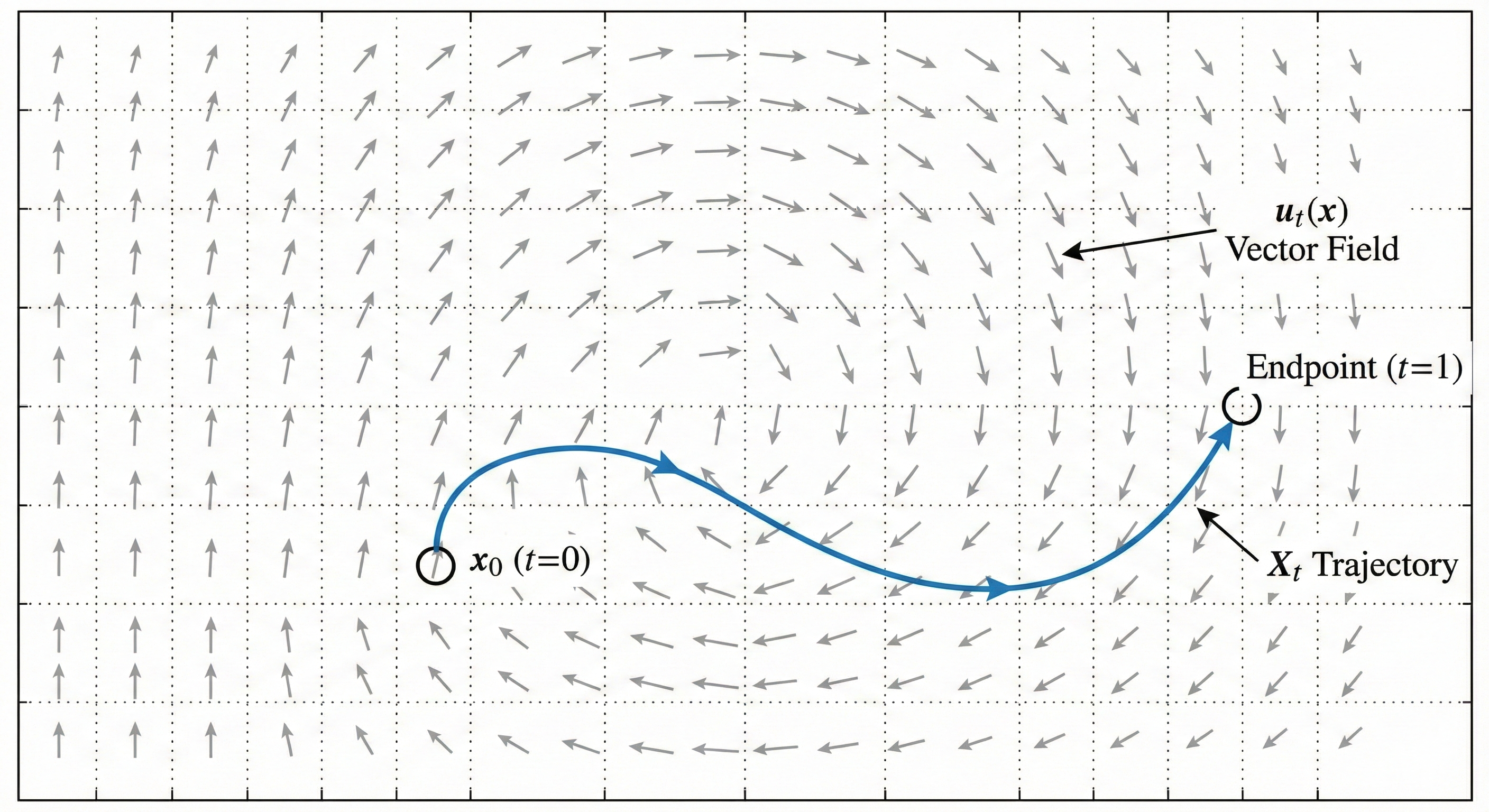
- Vector field \(u_t(x)\): The current at each point — it tells a particle “if you’re here, move in this direction”
- Trajectory \(X_t\): Following one leaf dropped in the river — where is that specific leaf at time \(t\)?
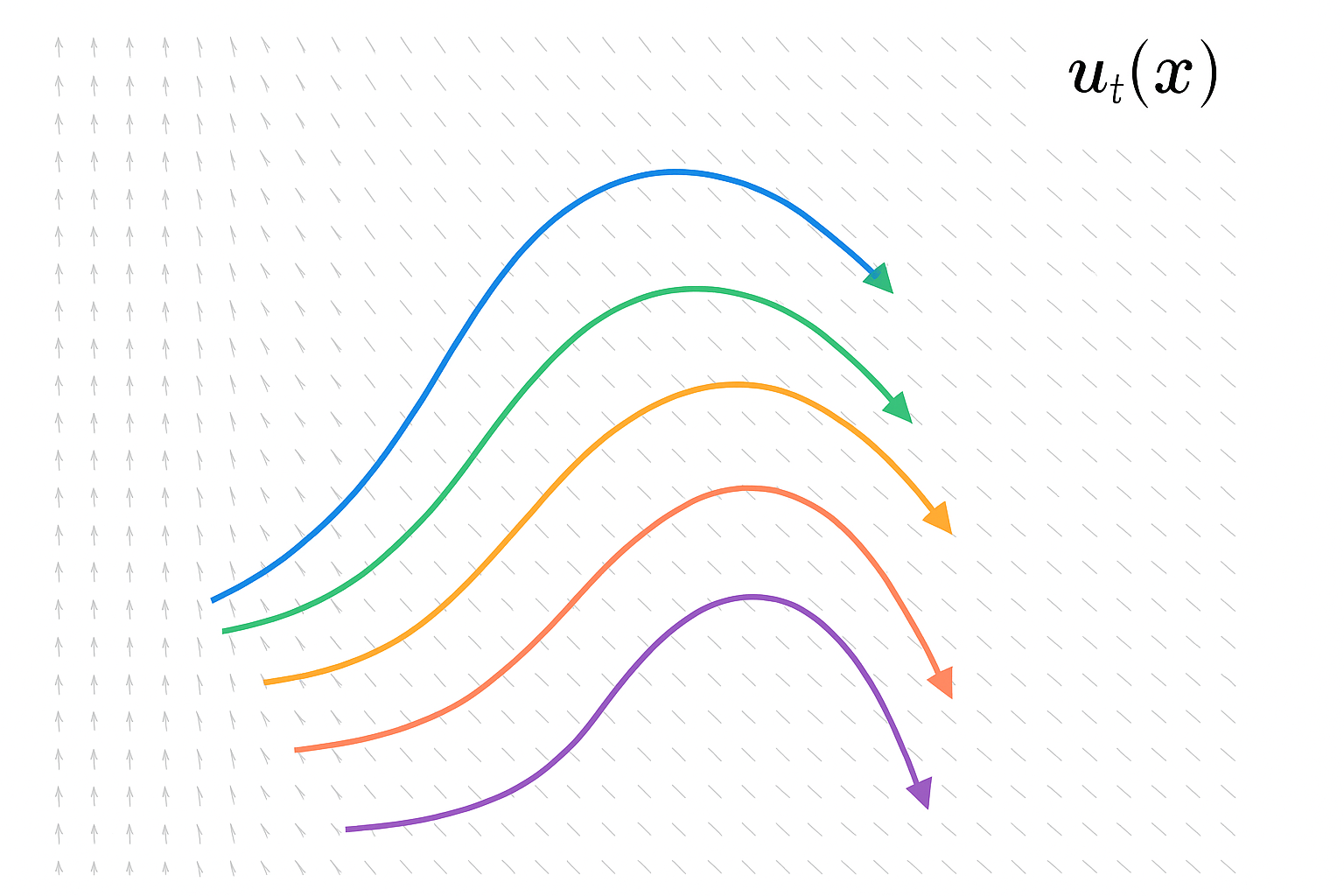
- Flow \(\phi_t(x)\): A map that answers “where does any leaf end up at time \(t\), given it started at position \(x\)?”
The key insight: \(X_t\) tracks one particle, while \(\phi_t\) describes how the entire space transforms over time.
Formal Definition
Every ODE is defined by a vector field \(u_t(x)\). A solution \(X_t\) starting from \(x_0\) must satisfy:
\[ \begin{aligned} \textcolor{blue}{\frac{dX_t}{dt}} &= \textcolor{green}{u_t}(\textcolor{orange}{X_t}) \\ X_0 &= x_0 \quad (\text{initial condition}) \end{aligned} \tag{1}\]
where \(\textcolor{blue}{\text{velocity}}\) equals the \(\textcolor{green}{\text{vector field}}\) evaluated at your \(\textcolor{orange}{\text{current position}}\).
In words: “your velocity equals whatever the vector field says at your current location.”
From Trajectory to Flow
The trajectory \(X_t\) answers: “where am I at time \(t\), given I started at \(x_0\)?”
But what if we want to know the answer for any starting point? That’s the flow \(\phi_t(x)\): a function that takes any starting position \(x\) and returns where it ends up at time \(t\).
\[ X_t = \phi_t(x_0) \]
For one specific starting point \(x_0\), the trajectory and flow give the same answer. But the flow is more general — it’s the entire “transformation rule” for all points.
Flow Equation
Since the flow satisfies the ODE, we can substitute \(X_t = \phi_t(x_0)\):
\[ \begin{aligned} \textcolor{blue}{\frac{dX_t}{dt}} = \textcolor{green}{u_t}(\textcolor{orange}{X_t}) \implies \textcolor{blue}{\frac{d \phi_t(x_0)}{dt}} = \textcolor{green}{u_t}(\textcolor{orange}{\phi_t(x_0)}) \\ X_0 = x_0 \implies \phi_0(x_0) = x_0 \end{aligned} \tag{2}\]
The second line says: at \(t=0\), every point is where it started (the flow is the identity map).
We established the core vocabulary: a vector field \(u_t(x)\) assigns directions to points in space, a trajectory \(X_t\) follows those directions from a single starting point, and a flow \(\phi_t(x)\) describes where all points end up. The relationship: \(X_t = \phi_t(x_0)\).
| Concept | Notation | What it answers |
|---|---|---|
| Vector field | \(u_t(x)\) | “What direction should I move at position \(x\)?” |
| Trajectory | \(X_t\) | “Where is this one particle at time \(t\)?” |
| Flow | \(\phi_t(x)\) | “Where does any point \(x\) end up at time \(t\)?” |
This is the foundation for everything that follows. In the next post, we’ll use flows to transform probability distributions — the key to generative modeling.
What’s Next?
We now understand how vector fields generate flows. But for generative modeling, we need flows that transform probability distributions — specifically, from noise to data.
In the next post, we’ll see how to construct probability paths that smoothly interpolate between a noise distribution and the data distribution, and the vector fields that generate them.